QR code vs. medical ID bracelet: which one should you use?
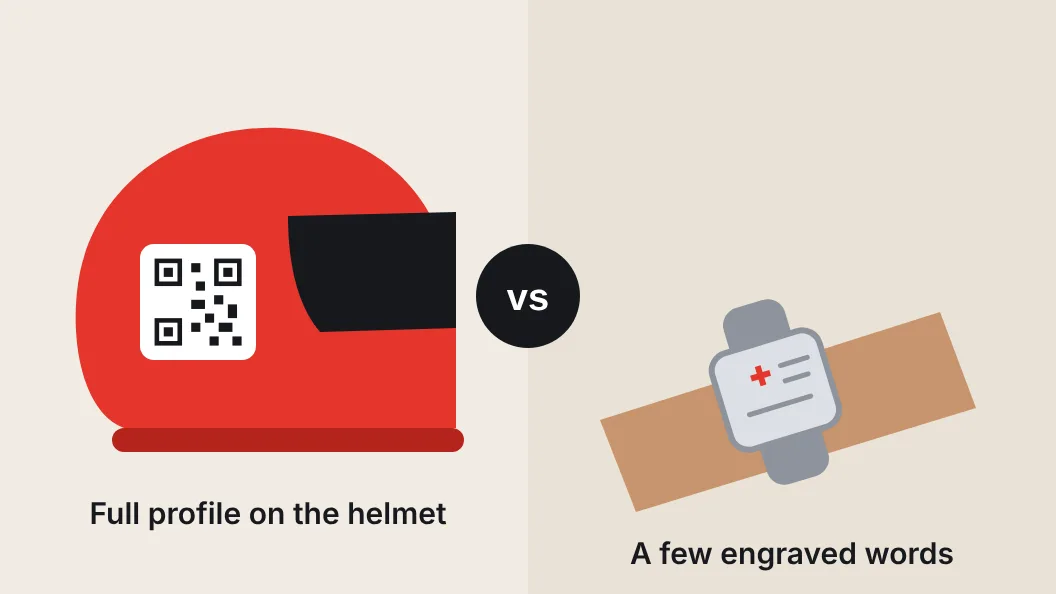
For a motorcycle rider, an emergency QR code on the helmet shows more information and is found sooner after a crash: it carries your full profile, updates instantly and lets a bystander alert your family. An engraved medical ID bracelet is better for people with a serious chronic condition who need it on them all day, off the bike too. Many people use both.
Updated on · By Pablo Porras (ChamoenMoto)
What is each one?
- Medical ID bracelet: a metal or silicone bracelet or tag with engraved details, usually your name, your main condition (diabetes, epilepsy, a severe allergy) and a phone number. You wear it on your wrist all day.
- Emergency QR code: a sticker with a code that anyone can scan with a phone camera to open a medical profile with the details you choose. On a motorcycle it goes on the helmet and the tank. We explain it in what is an emergency QR code.
Some bracelets now come with an engraved QR code. They combine both ideas: always on your wrist, but the code is small and responders need to know it is there.
How do they compare?
| Emergency QR code (MásVidas) | Engraved medical ID bracelet | |
|---|---|---|
| Information shown | The profile you build: blood type, allergies, conditions, medications, insurance | What fits in an engraving: a few words |
| Where it goes | Helmet, tank, fender or car, in plain sight | Wrist or neck |
| How it is read | Scanned with a phone camera; has an offline version | At a glance, no device needed |
| Updating a detail | Instantly, from your dashboard | Engrave or buy a new one |
| Alerting family | Yes, with one tap, without showing their numbers | Only if someone calls the engraved number |
| Privacy | You choose what is public and what is private | Anyone can read the engraving |
| Off the bike | Only when you have your helmet or vehicle | Always with you |
| Cost | US$4.99 a year | One-time purchase |
Which one do responders see first after a motorcycle crash?
The helmet. It is the first thing a bystander sees, and first-aid guidance says to leave it on. A sticker with the red MásVidas cross and the word “Scan” is noticed in seconds; a bracelet can end up under a glove or a jacket sleeve, and someone has to know to look for it.
That is why we recommend putting the QR code on the helmet and repeating it on the tank or fender. If you are thrown from the bike, the helmet stays with you. More in motorcycle accident first aid.
When is a medical ID bracelet the better choice?
- If you have a condition that can cause an emergency at any time: type 1 diabetes, epilepsy, an allergy that causes anaphylaxis, or if you take blood thinners.
- If you want your information on you all day, walking, at work or playing sports.
- If you prefer something that can be read without a phone.
When is an emergency QR code the better choice?
- If you ride a motorcycle, even just to commute: your helmet is the natural place for your ID.
- If your details change: a new medication, new insurance, a different emergency contact.
- If you want whoever helps you to alert your family without seeing their numbers.
- If you want to decide which details are public and which are not.
Can you use both?
Yes, and it is what we recommend for riders with a serious medical condition. The bracelet flags the urgent issue even when you are not wearing your helmet; the QR code adds the full profile, insurance and medications, and alerts your family. Put the same information in your MásVidas profile that is engraved on the bracelet so they never contradict each other.
Frequently asked questions
Do paramedics scan QR codes?
The first person at a crash is rarely a paramedic: it is usually another rider, a driver or a police officer, and they all carry a phone with a camera. The MásVidas sticker says “Escanea / Scan” next to the code so nobody hesitates. From your dashboard you can also print an offline version that shows vital details even with no signal on the road.
What if the person helping me has no internet?
The PDF you print from your dashboard has two codes: an online one that opens your full profile and lets them alert your family, and an offline one that stores your vital details, such as blood type and allergies, inside the code itself. So even with no coverage, whoever helps you can pass that information on to paramedics.
Is a medical ID bracelet good for motorcycle riders?
It helps, especially if you have a serious chronic condition, but it has two limits on a bike. It can be hidden under a glove or jacket, and it only fits a line of text. That is why many riders wear the bracelet for the urgent issue and put a QR code on the helmet for the full profile and the family alert.